

From landing a job and designing a custom inlay, to unique framing and board bending – award winning deck builder Dave Settlemyer discusses his process for building inlaid decks.

Above & Beyond
The custom deck building industry is undergoing a transformation. High-end builders are pushing the bounds of what can be done with a deck board, and the results are stunning. Intricate patterns featuring curvilinear shapes with astonishing complexity have transformed deck building into an art form and given a leg up to those builders who have added this skill to their repertoire. Homeowners may not know the ins and outs of deck building, but the difference between a standard deck and an inlaid deck is self-evident. Many are willing to pay top dollar for the charm an inlay can provide to their outdoor space.
However, for many deck builders this may seem like a daunting skill to learn. There isn’t necessarily a playbook on how to get started, and very few builders have mastered the art of inlay design, meaning it can be difficult to find a mentor to show you the way.
Despite this, a select few like Dave Settlemyer of LS Underground have persevered and can serve as a tremendous resource for those just starting out.
Dave Settlemyer is a professional deck builder and landscaper, and the owner of LS Underground in Denver, Colorado, which specializes in elaborate inlay designs for both decking and hardscapes. He was recently recognized by NADRA as the first place winner for Best Product Display as well as Best Inlay Project in the 2022 National Deck+ Awards — an annual industry showcase where Dave’s work has been a staple over the past few years.
According to Dave, when competing at this level, “You can’t achieve with mediocrity. You have to go above and beyond, and the easy stuff is not going to win.”
We spoke with Dave to gain some insight into the process of inlay building and all that it entails – from landing a job, to planning and execution, as well as the benefits that offering these specialized services can provide for your business.
Take the Initiative
The first step is to open the client’s mind to the endless possibilities. Homeowners are often excited by the idea that they can have a one-of-a-kind inlay that no one else in the world has on their deck. However, since few builders offer this service, most homeowners either don’t know that inlays are an option, or they are unaware that the builder they’ve hired can produce them.
“If I left [the design] up to the client, I would never get a chance,” said Dave, “The average homeowner isn’t aware of what the possibilities are.”
It’s up to the builder to take the initiative and walk the homeowner through their options. Dave finds that most homeowners ask for somewhat standard designs, like an area rug pattern or a rectangle in the middle of the deck. It’s up to him to push the envelope and test his limits.
Complexity is Key
After the decision is made to go with a custom inlay, it’s time to begin working on the design. According to Dave, there isn’t necessarily a science to the design itself.
“It’s original to every project and it’s just what I am feeling at the time of working on the design,” said Dave, “I try to make everything as complicated as possible.”
It’s that complexity that helped Dave to win the Best Inlay Project Award in 2022. “I created multiple quadrilateral shapes, the rectangles of different sizes and squares, and then tied all of those together with the ribbon shape of the curvature.”
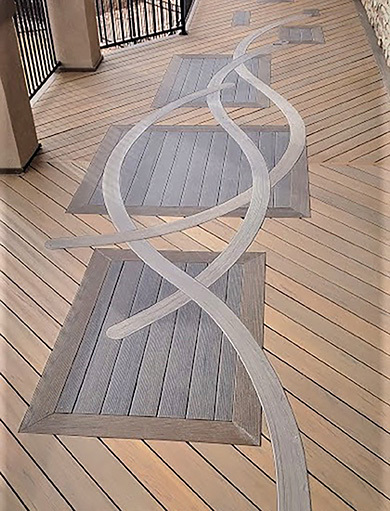
For those just starting out, more basic shapes like squares, rectangles and diagonals can act as a steppingstone to more complex designs with curves and more intricate shapes.
Regardless of the design, it must be set before moving onto framing.
Framing Challenges
When framing for an inlaid deck, unique situations often arise that require precise planning beyond that of a standard deck. It’s important to survey the job and prepare for these challenges before building.
For example, Dave’s winning project was built atop a waterproof drainage system, meaning he had to be careful not to create water dams and to allow for free drainage. According to Dave, this made for the most complicated build he’s ever done.
“We had to do three or four steps of blocking before the rain bladder went in, and after the fact too. So, we had to do a lot of prep work on the frame to accommodate the blocking.”
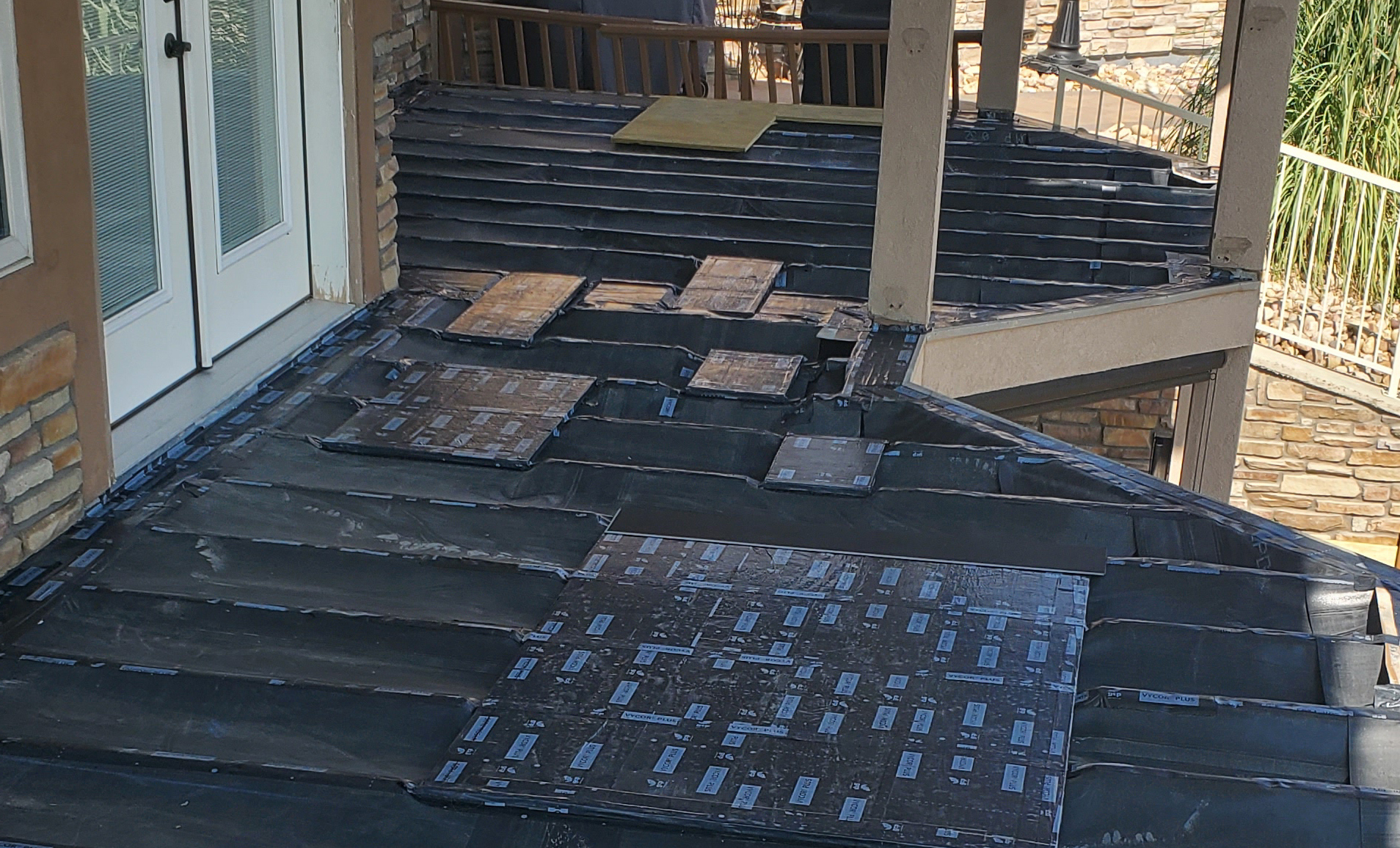
In this scenario it meant blocking both above and below the waterproof bladder, maintaining a slope to direct water toward one end of the deck without creating pools under the deck. Dave also had to trace his inlay pattern out on both sets of blocking.
We asked Dave what fasteners he uses to ensure the structural integrity of his decks given the complex framing they often require.
“We use all of the LOK products, HeadLOKs, LedgerLOKs, FlatLOKs. From a structural standpoint, it creates a very, very strong structure. And the key blocking is for the pattern. You know, when I do that, and that’s all underneath the deck, I have to make sure that there is never going to be a problem.”
FastenMaster’s LOK Line of heavy-duty wood screws are the quickest and easiest way to create code-compliant structural connections. The speed of installation is perfect for situations where extra reinforcement blocking is necessary, while providing the structural strength needed for the project. All FastenMaster fasteners are also guaranteed to last the life of the project.
Piecing it Together
After the inlay design has been finalized and the framing has been built with the necessary previsions, it’s time to start piecing together the inlay itself.
Start by laying out the boards and tracing the design on top. For curved inlays, the boards must be bent prior to installation. Dave uses a process involving heating blankets to raise the temperature of the boards up to about 235ºF (113ºC). While Dave’s award-winning inlay was built using composite decking, PVC boards are easier to manipulate and bend.
“It’s starting slow and working the temperatures up gradually of each board and each bend is going to be roughly 4 hours from start to finish,” explained Dave, “and then after that 4 hours of heating and manipulating the board, we let them cool overnight so they can cool down very gradually at room temperature.”
Curving deck boards is an art in and of itself – it takes patience and persistence to perfect, but the finished product is well worth the time and effort.
Once the boards are laid out and the design is traced, the inlay can be cut out and fastened into the framing. When we asked Dave, he said there’s only one fastening method he would recommend:
“Only Cortex and plugs. You have to use the Cortex system to control the expansion and contraction. We’re very happy because of the match that we’re able to get on our Cortex plugs too. And especially since you guys collated those plugs, it’s so much easier.”
The Collated Cortex Hidden Deck Fastening System allows you to hide all the fasteners on the surface of your deck and is the only way to seamlessly fasten decking inlays. Cortex provides a perfect match to leading deck boards and leaves a virtually invisible finish.
Trial & Error
It takes time and effort to learn the art of inlay building – each deck has its own unique challenges, requiring robust problem-solving skills that are developed with experience. It took Dave years to reach the level he is at now.
LS Underground began as a landscaping business before Dave ventured into deck building in 2018. After Dave mastered standard decking, he moved onto more complex patterns.
“I just started with basic square and rectangle, like everyone else, and the intention is to do better and get better on every project,” explained Dave, “and so every project from that original square we moved up, to 45-degree angles, which was the obvious next step, but then we got into curvature.”
According to Dave, there is no set path for learning a skill like this, and failure is inevitable, but that’s all part of the learning process.
“I am 100% self-educated with what I’ve done. There’s nobody around to teach, so there’s a lot of trial and error.” Dave added that online resources, like YouTube, can be valuable for learning, with creators like DrDecks sharing in-depth videos detailing his process for tackling complex builds as well as valuable tips and tricks of the trade.
A Highly Creative Thing
Inlays require additional time, effort, and may incur excess material and labor costs beyond that of a standard deck. However, the ability to deliver a finished product that is uniquely personalized to the client’s desires is a game-changer for those who are capable. Deck inlays can provide a strong competitive advantage over the competition and enable builders who have the necessary skills to charge a premium for their services.
These intricate inlay designs are a big part of what has put LS Underground on the map. They’ve resulted in several national awards and have opened new doors for Dave and his business that never would have been possible. However, this isn’t why he does it. According to Dave, “It’s more to express your creativity and your level of knowledge and skill in building. It’s a highly creative thing, and that’s what I try to put into every project.”

Check out more of Dave’s work on his website, or check out his award winning builds, featured in the NADRA 2022 National+ Deck Awards.